
Tasacak Bu Deniz Episode 5 Analysis: Betrayal, Revenge, and Secrets Beneath the Surface

When the Sea Becomes a Mirror
Turkish television’s latest high-stakes drama, Taşacak Bu Deniz (“This Sea Will Overflow”), continues to redefine narrative intensity. Episode 5, directed by Çağrı Bayrak, turns the emotional tide inward — from public feuds to private reckonings.
Adil’s relentless drive for vengeance reaches catastrophic scale, Esme’s moral courage is tested to breaking point, and Eleni’s journey toward her origins transforms the series into something deeper — a meditation on identity and justice.
With commanding performances from Ulaş Tuna Astepe (Adil), Deniz Baysal (Esme), and Ava Yaman (Eleni), Episode 5 positions Taşacak Bu Deniz as a modern classic of Turkish melodrama — visually poetic yet politically sharp.
Adil demolishes Esme’s guesthouse, erasing her past and closing the painful chapter between them. He ends their personal feud but launches a massive legal war against the Furtuna family. Despite Esme’s attempts to stop him, Adil manipulates the villagers with strategic precision, breaking their trust in Sheriff and the Furtunas.
At the same time, Sheriff sets a ruthless plan in motion: to reclaim the land and money by poisoning tens of thousands of goats belonging to Adil’s side.
Meanwhile, Melina gives Oruç a photograph revealing that Eleni was sold as a baby in Istanbul. Determined to find her birth mother, Eleni decides to travel to Istanbul with Oruç — a decision that devastates Adil, who watches her leave in silence.
As Esme joins Adil in fighting to save the poisoned goats, she learns that Eleni’s mother is a member of the Furtuna family. The discovery shakes her to the core, proving that the sea between love and hate is far smaller than anyone imagined.
Adil’s Revenge: The Architecture of Destruction
Every episode of Taşacak Bu Deniz has pushed Adil closer to moral collapse, but Episode 5 captures the full cost of his crusade. His demolition of Esme’s guesthouse isn’t just a physical act — it’s an erasure of memory, intimacy, and conscience.
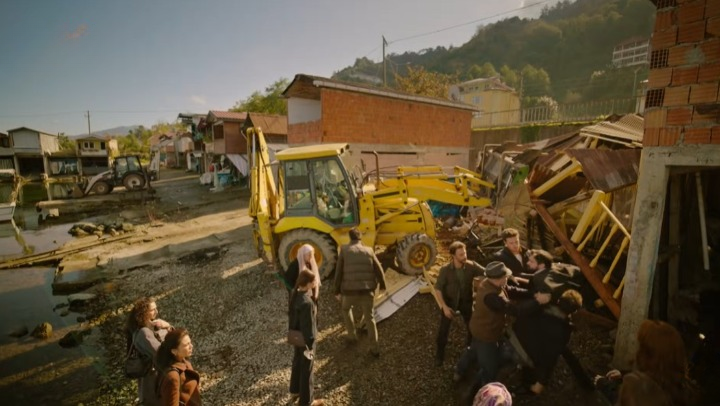
Adil’s vendetta against the Furtuna family grows into a war of manipulation. Through calculated speeches and legal maneuvers, he dismantles their public reputation. But beneath the precision lies emptiness — a man building his power on ashes.
Ulaş Tuna Astepe delivers an extraordinary performance, balancing quiet rage with weary vulnerability. His Adil is no longer a hero — he’s a man devoured by justice turned obsession.
“The law can destroy the guilty,” Adil says, “but it cannot resurrect the innocent.”
The line lands as the moral thesis of the series — power without empathy becomes another form of cruelty.
Esme’s Defiance: The Conscience of the Storm
As Adil sinks deeper into vengeance, Esme emerges as the show’s emotional centre. Her determination to stop Adil from consuming himself gives Episode 5 its heartbeat.
Deniz Baysal plays Esme not as a victim but as moral resistance. When the goats are poisoned — an ecological and ethical catastrophe — she stands beside Adil, not in forgiveness, but in shared grief.
Their partnership, forged in tragedy, feels less romantic and more spiritual — two people bound by what they’ve lost, not what they hope to regain.

Her revelation about Eleni’s mother — a Furtuna — brings the episode’s themes full circle. The feud she has fought to escape becomes, again, her prison.
Sheriff’s Revenge: Poison as Metaphor
Sheriff’s (played by Aytek Sayan) plan to poison the goat herds operates on multiple levels: literal, symbolic, and moral. It’s revenge through annihilation — destruction of livelihood, life, and innocence.
The sequence is filmed with almost unbearable stillness. We see wide, arid fields under a pale sky, the sound fading as animals fall one by one. Çağrı Bayrak directs the moment not as spectacle but as moral horror — a portrait of vengeance eating itself alive.
The poisoned land becomes a mirror for human corruption, recalling classic Turkish allegories about greed and spiritual decay.
Eleni’s Journey: The Search for Origins
Eleni’s storyline introduces Taşacak Bu Deniz’s most intimate transformation. When Melina (a quietly haunting Zarife, played by Yeşim Ceren Bozoğlu) gives Oruç the photograph proving Eleni was sold as a baby, the series shifts from rural feud to urban odyssey.
Eleni’s decision to go to Istanbul with Oruç (played by Burak Yörük) marks her emotional emancipation. Her departure leaves Adil hollow — love turns to distance, and distance to realization.
Yet the discovery that her mother belongs to the Furtuna family connects her personal truth to the show’s central conflict. She is both the wound and the bridge — a child born of enmity, destined to reconcile it.
Ava Yaman’s performance brings fragile grace to the role — a quiet strength that feels both modern and mythic.
Direction & Cinematography: Beauty in Ruin
Director Çağrı Bayrak continues to prove his mastery in crafting cinematic television. Episode 5 is visually stunning yet emotionally suffocating.
Cinematographer Tolga Çetin uses landscape as character:
- The Sea — a symbol of cleansing and destruction, ever-present in Adil’s inner turmoil.
- The Land — a battlefield for legacy, drenched in dust and loss.
- The Ruins — Esme’s inn, crumbling under both bulldozers and memory.
The palette shifts from warm daylight to cold steel-blue — mirroring the erosion of humanity as revenge consumes everything.
Themes: Justice, Identity, and the Cycles of Pain
Episode 5 consolidates Taşacak Bu Deniz’s core philosophy — that justice and revenge are twin illusions.
- Justice without compassion becomes tyranny.
- Love without truth becomes dependency.
- Identity without history becomes exile.
Each character carries a private guilt. Adil’s obsession, Esme’s hope, Eleni’s confusion — all echo the same question: Can one escape the past, or does it simply change form?
The poisoning of the goats serves as ecological allegory — nature punishing human arrogance. In the hands of Çağrı Bayrak, even silence feels political.
Cultural Resonance: Rural Feud, National Mirror
Like many modern Turkish dramas, Taşacak Bu Deniz uses local conflict to reflect national anxiety. The Furtuna–Adil feud becomes a metaphor for class struggle, rural displacement, and the wounds of modernization.
Esme’s destroyed inn represents the vanishing old Turkey — communal, moral, fragile. Adil’s lawsuits and corporate tactics embody the ruthless new order, legal but soulless.
In this light, Episode 5 transcends soap opera: it becomes a moral fable about progress and loss.
Critical Analysis: When the Sea Overflows
Episode 5 positions Taşacak Bu Deniz as more than a domestic drama — it’s moral poetry. The title, “This Sea Will Overflow,” feels prophetic.
By the end of the episode, both literal and emotional floods loom: land poisoned, families shattered, and truths rising from beneath years of deceit.
This is Turkish drama at its most ambitious — not content with heartbreak, but intent on exploring the psychology of revenge.
As Variety might put it: “What began as melodrama has matured into allegory — a reflection of a nation’s struggle between retribution and reconciliation.”
Conclusion: When Vengeance Becomes the Tide
The final frames of Episode 5 linger: Adil and Esme standing among poisoned fields, wind carrying silence heavier than words.
Eleni’s journey to Istanbul offers hope — a reminder that even in devastation, truth can be reborn. Yet for Adil, the sea has already overflowed, washing away everything he once stood for.
Taşacak Bu Deniz continues to evolve into one of the most ambitious Turkish dramas of the decade — emotionally fearless, visually arresting, and morally complex.
Source: TRT1, IMDB, Dizitrack
Image Gallery


About Author
Rashida Yasmeen
An international media analyst specializing in Turkish and global television trends. With expertise in drama storytelling, audience engagement, and cross-cultural media, she provides in-depth analysis and fresh perspectives on the evolving entertainment landscape for readers worldwide.