
Taşacak Bu Deniz Episode 2 Review: Chaos, Compassion, and Conflict in a Divided Village

A Riveting Continuation of a Tragic Tale
The second episode of Taşacak Bu Deniz (“This Sea Will Overflow”) plunges deeper into the emotional undertow of love, vengeance, and societal division. Following the explosive premiere, this chapter expands the moral and emotional complexity of its characters while anchoring them in a vivid portrait of an Aegean village torn apart by history and pride.
Where Episode 1 introduced us to Adil a man haunted by the past and Eleni, the Greek doctor whose mere presence unsettles the village, Episode 2 transforms their story into a high-stakes emotional thriller. From its opening moments, the show strikes a balance between visceral realism and poetic tragedy, a hallmark of modern Turkish television’s global renaissance.
Adil and Eleni, after a devastating car accident, find themselves fighting for their lives in the midst of a deadly ambush orchestrated by Gökhan and his men. As bullets fly and survival seems uncertain, Esme the resilient matriarch of the village — arrives just in time to save them.
Adil, furious and determined, vows to avenge the attack on Eleni, while gossip spreads like wildfire: “The Greek doctor and Koçari are together.” In this small community, whispers are weapons. Meanwhile, Oruç’s engagement preparations with Sevcan gather pace, setting the stage for a collision of personal loyalties and public shame.
As tensions rise, Eleni now shunned by the villagers grows weak and falls ill. On the shore, Oruç encounters her and, against the tide of hatred, helps her, entrusting her care to Esme. Despite the entire village’s outrage, Esme defies tradition and nurtures Eleni “as if she were her own daughter.”
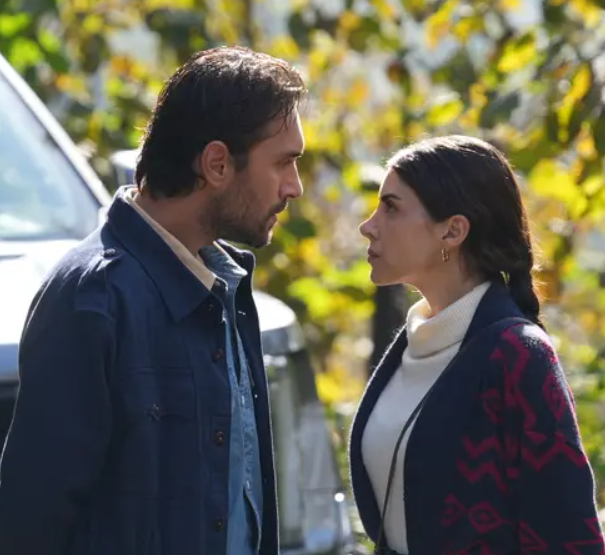
The episode reaches its emotional climax during Oruç and Sevcan’s engagement ceremony. Adil storms in, demanding the land that is rightfully his property once taken by blood. The confrontation between Adil and Esme crackles with unresolved pain, pride, and justice. Yet, unknown to Eleni, a darker plot unfolds elsewhere: Sheriff, from behind prison walls, issues the order for her death.
Eleni remains unaware that while she heals in the warmth of Esme’s home, danger lurks closer than ever.
Thematic Analysis: Between Humanity and Hatred
Taşacak Bu Deniz continues to prove that Turkish television has mastered the art of weaving melodrama with sociopolitical realism. Episode 2 isn’t merely about a car accident or village gossip — it’s about the weight of inherited prejudice, the courage of compassion, and the inevitability of violence when history refuses to stay buried.
At its core, the series juxtaposes individual humanity against collective hatred. Eleni, the “other,” becomes both healer and victim a doctor who saves lives but is condemned for her identity. Adil’s fury is not just personal vengeance; it’s a man’s attempt to reclaim agency in a world that continually denies him peace.
Esme, portrayed with quiet intensity, emerges as the episode’s moral compass. Her decision to care for Eleni defies the patriarchal codes of her community, offering a rare moment of tenderness amid the show’s darkness. Her defiance signals a recurring theme: that compassion is the most radical form of resistance.
Character Arcs: The Human Faces of Conflict

Adil – The Reluctant Avenger
Adil’s transformation from survivor to seeker of justice anchors the episode. His motivations are layered part revenge, part guilt, part protection. The writing allows viewers to feel his moral struggle; each decision he makes carries the weight of trauma and pride. His confrontation with Esme is not just about land, but legacy a metaphor for how history divides families, communities, and nations.
Eleni – The Outsider’s Burden
Eleni’s descent from respected doctor to exiled outcast is heartbreaking. Her vulnerability — physical, emotional, and social — mirrors the precarious position of anyone who dares to cross cultural borders. Yet her quiet dignity and will to survive transform her into the emotional center of the series. Through her, Taşacak Bu Deniz explores the gendered dimensions of belonging and exile.
Esme – The Heart of the Village
If the sea is the series’ metaphor for fate, Esme is its shoreline — a steadfast presence that absorbs the waves of others’ pain. Her decision to shelter Eleni against communal outrage elevates her from background character to moral protagonist. Her story also challenges the rigid social structures of rural Turkey, where hospitality and honor often collide.
Oruç – The Torn Heir
Oruç’s role evolves from a symbol of traditional duty into one of internal conflict. His compassion for Eleni disrupts his own engagement and social standing, hinting at a larger arc about personal conscience versus public expectation.
Cinematography and Direction: A Visual Poem
The visual language of Episode 2 is nothing short of stunning. The director leans heavily on natural light, muted tones, and wide coastal shots, emphasizing the isolation of both landscape and character. Each frame feels painterly — the Aegean Sea functions as both witness and metaphor, its unpredictable tides mirroring the emotional volatility of the story.
The car crash sequence is a masterclass in controlled chaos: disorienting but never gratuitous. Later scenes — especially Eleni collapsing on the beach are shot with a tenderness that contrasts sharply with the brutality of village gossip. This tonal balance between violence and vulnerability is where Taşacak Bu Deniz truly excels.
Cultural Context: The Echoes of History
To international viewers, the series’ exploration of Turkish-Greek tension may read as historical fiction. Yet for local audiences, it resonates as lived memory. The show deftly integrates real-world echoes of cultural displacement, prejudice, and national trauma without veering into didacticism.
By situating personal drama within a politically charged backdrop, Taşacak Bu Deniz invites viewers to question inherited narratives: Who belongs, and who decides? What happens when compassion crosses borders drawn by old wounds?
This is not just a love story — it’s an allegory about reconciliation, identity, and the cost of peace.
Writing and Dialogue: The Music of Conflict
The script’s dialogue is carefully balanced between poetic restraint and raw emotion. Lines like “She’s not my daughter, but my heart knows no borders” (Esme) and “Blood may claim land, but mercy claims souls” (Adil) echo the series’ central tension: justice versus forgiveness.
The show’s writers resist the temptation of melodrama, instead opting for quiet devastation. Even when guns fire, it’s the silences that speak louder — the glance between Eleni and Oruç, the hesitation before Adil raises his weapon. This restraint elevates Taşacak Bu Deniz from a simple village saga to a literary television drama.
Global Appeal and Why It Matters
With Turkish series increasingly dominating international streaming platforms — from Latin America to the Middle East — Taşacak Bu Deniz stands poised to join the ranks of Diriliş: Ertuğrul and Yalı Çapkını in global recognition.
Episode 2, in particular, showcases why international audiences are drawn to Turkish storytelling: emotional authenticity, complex morality, and cinematography that rivals European arthouse cinema.
Its themes of prejudice, love, and survival are universal, transcending language barriers. For global viewers seeking emotional realism wrapped in cinematic beauty, Taşacak Bu Deniz is more than a drama — it’s a cultural experience.
Final Thoughts: A Sea That Truly Overflows
By the end of Episode 2, the title “Taşacak Bu Deniz” takes on new meaning. The “sea” isn’t just the geographical heart of the story — it symbolizes overflowing emotion, rage, and compassion. Every character stands on its shore, waiting for the tide to either wash them clean or pull them under.
In this episode, we witness not just the continuation of a story, but the deepening of a moral universe. Few shows capture the human condition with such haunting grace.
Rating: (5/5)
Taşacak Bu Deniz – Episode 2 is a triumph of storytelling, combining visceral realism with emotional poetry. It’s a must-watch for anyone drawn to dramas that explore the fragile balance between love and hate, tradition and progress, vengeance and mercy.
Final Thought
Episode 2 of Taşacak Bu Deniz cements the show’s reputation as one of the most emotionally charged and socially resonant Turkish dramas of recent years. It’s a story of survival and conscience, of borders both seen and unseen.
In a television landscape saturated with spectacle, this series dares to be sincere — and in doing so, it overflows with humanity.
About Author
Rashida Yasmeen
An international media analyst specializing in Turkish and global television trends. With expertise in drama storytelling, audience engagement, and cross-cultural media, she provides in-depth analysis and fresh perspectives on the evolving entertainment landscape for readers worldwide.